Sorry readers, but this isn’t about cake.
It is however partially about my own beef with the oddly complicated issue of substituting animal leather for other materials, and at least the personal lived experience of this for a slightly lazy consumer like myself.
So, it’s a little difficult for me to talk about this subject without giving some tiny reference to my day job, and for the sake of privacy, I’ll try. But, what I will say is that on occasion, I’ve at least loosely introduced the topic of fast fashion and fashion-related waste not to guilt trip, frighten, or pontificate any personal beliefs I might have about this incredibly complicated issue, but at least to generate some conversation or thought about it. Whether or not I succeed in doing this is a whole other discussion.
Of course I wouldn’t be doing right by myself or my students if I didn’t at least admit that in spite of my best intentions to encourage others to think carefully about the clothes they buy, I too have also shown poor decision-making in this aspect of my life.
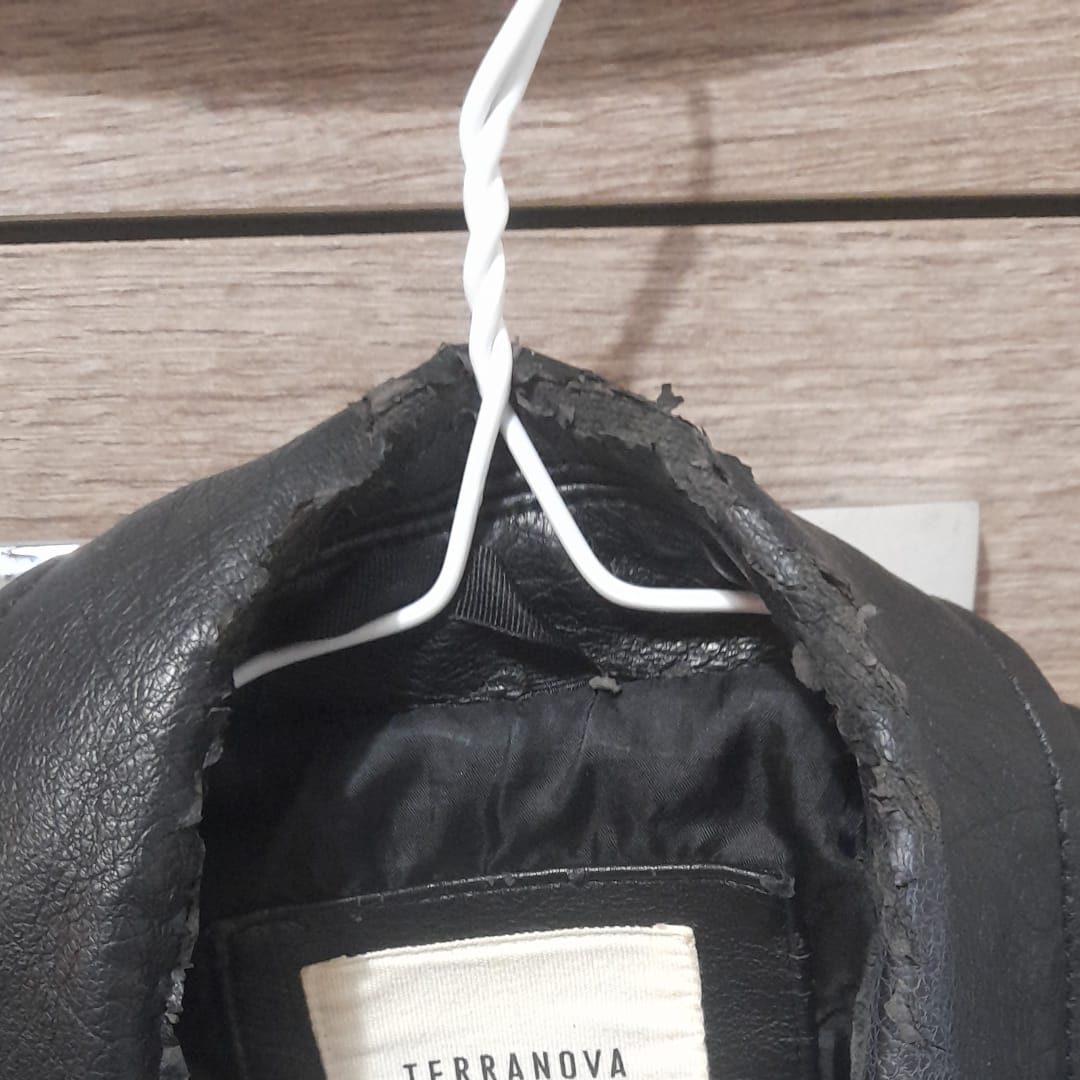
A recent example of this is a faux leather jacket I bought from Terranova, an Italian fashion brand which was started in 1988 by The Teddy Group in Rimini. I won’t go into any real detail about how much of the blame is on them, as there are many other companies, and I believe the problem is a bit more complicated, despite a mainstream tendency to lay all or most of the blame on fast-fashion companies alone.
Afterall, we the consumer need to take at least a little accountability for the continuation of the over-consumption of more affordable clothes and accessories. This is what I hope to do by the end of this post, but to also give thought to some other contributing factors along the way.
So, the black faux leather jacket I had bought approximately two years ago, cost me about fifty euro. Not a huge amount of money, but like most ordinary people on a limited income, I expected a certain level of quality (or at least longevity). I tried it on, felt that familiar thrill of knowing how good I looked in it, and delighted in the renewed confidence I had while wearing it. I was a little disappointed about the absence of the smell that comes with real leather, but didn’t give it too much thought. The little dopamine kick was too good to resist as I made my purchase.
I had turned a blind eye to the little tag which would’ve told me that the lining was made of 100% polyester, the coating 100% polyurethane (often used for a leather effect), and the fabric was 82% polyester, 15% cotton and 3% viscose. These days, it’s probably a rather standard practice for most fast-fashion stores to manufacture their leather substitute jackets in this way, as at least a few sources may claim that it’s a more economically sound way of mass-producing the same jacket without making too much of an environmental impact, right?
But what about the long term?
What about the person who spends their hard earned money on something that will almost inevitably fall apart?
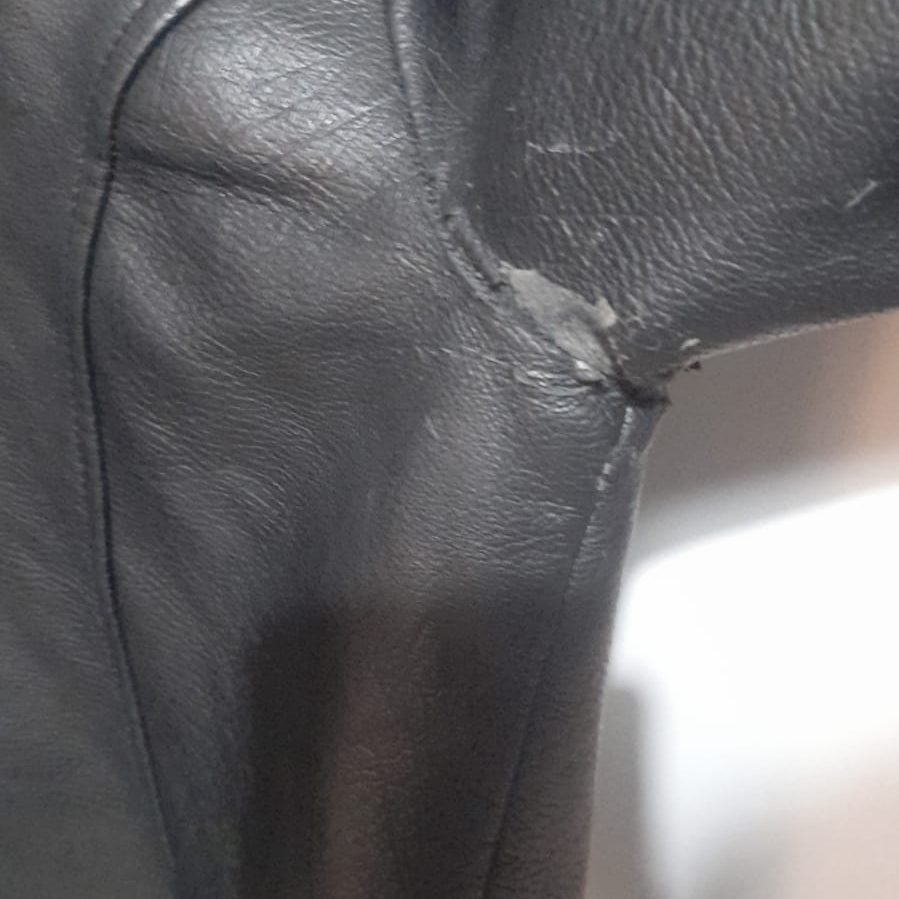
After barely two years of owning the jacket, I’ve noticed the cracks beginning to show. I would usually expect some wear and tear by now, as I’ve worn it on quite a few occasions, but far from being every day. As you’ll notice from the photos I’ve included, the jacket is in very poor condition around the collar and armpits, and even around the zipper pockets. The external fabric is so badly torn that it almost looks like it’s flaking. You’d almost think I had been wearing it whilst running through fir trees like a scene out of Harry Potter.
If this had been obvious much earlier on, I certainly would’ve gone down the usual route of filing a formal complaint. But even then, the likelihood of my particular case being taken seriously, probably would’ve been very low. The necessary information was all there and accounted for, as far as the fashion company and their chain store were concerned, and I had failed to educate myself sufficiently on the matter to make a sound decision, or even to set myself up for a proper defense. The thing is, if I had at least known what to expect regarding the longevity of the polyurethane coating on the jacket, I probably would have been in a better buying position.
So alas, no refund!
I don’t consider myself to be a shopaholic. Quite the contrary – as I get older, I try to be less trigger-happy in the way I go about clothes shopping. Post-lockdown, I had mostly stopped purchasing my clothes online and have tried to resist the ever-tempting allure of Amazon Prime. I usually take quite a bit of time in weighing up all the usual factors of affordability, aesthetic, and what I hope would be sustainability. I slip up from time to time, and sadly it is always those slip-ups wherein my problem lies. It’s a shallow, petty, self-gratifying part of my human nature which I need to wrestle with every time I go anywhere near a clothes shop. It’s also the part which the world of business on a retail level loves to frequently exploit in spite of itself.
But looking back at this tatty jacket which like many poorly manufactured products, is destined for the recycling (or more than likely, the landfill), I wonder who the biggest winners and losers truly are in this near-historic problem of balancing it all – quality, affordability, sustainability, fairness, etc. At least for my part, I am uncomfortably aware that my fifty euro feeds the waste problem to some degree. I am also uncomfortably aware that for every bag full of lesser quality clothing I buy, I could probably spend the same amount on one or two items which would have lasted much longer and I could have handed such items down to the next generation (hooray for vintage).
But where are these better quality items? Do they even exist anymore? And in the long run, how big of a price will we actually pay for items which won’t even last longer than a year?
Sadly, I would very much like to live in that make-believe world where the everyday person doesn’t have to worry about where the faux leather comes from, who makes it, or where it will actually end up after I’ve disposed of it. I would very much like to go to sleep at night believing and knowing 100% of the time that every item of clothing I have ever put on my back was fairly manufactured, that the materials were ethically sourced, and that the materials if they end up in the ground won’t cause any serious long-term damage to the ground, to food, to wildlife, to my physical health or the health of my future offspring.
But, we don’t live there.
And, whether I wish to acknowledge it or not, I must also sadly face a few hard facts about the very things I openly question . . .
Firstly, many fast-fashion brands have been putting clothes on my back for probably most of my life. My parents were not wealthy people and they’ve lived within their means to the best of their ability. This included shopping at many well-known fast fashion stores.
Also, I spent a great deal of my own pocket money on brands like Primark, New Look, H&M, etc. brands which despite their issues have provided generations of young people like me with easier access to an overwhelming abundance in style and clothing options. It may seem like a petty superficial thing, but even when I was a teenager, that offered a small but meaningful sense of personal autonomy, almost like a rite of passage especially for a teenage girl. It’s an age old part of human nature that I doubt will change anytime in the near future. We all enjoy peacocking a little (or a lot).
And, as I’ve said before with my mention of a “lazy” consumer, the problem at least in my own part is also this – I like things to be easy, convenient, simple. I don’t want to consciously think about the clothes I put on my back unless it’s for the purpose of drawing attention to or away from myself.
Furthermore, there’s a culture and ritual we’ve created for ourselves around shopping. Many many years ago it would have only been a pastime for wealthier families, but nowadays, even if you have a relatively small budget, you could make a daytrip to Primark and come home with cartoonishly large bags of items at a relatively low cost – a bit of a miracle in a superficial sort of way!
Finally, how many young people have benefitted from their first job in a fast-fashion store? I’m just old fashioned enough to use the expression “don’t bite the hand that feeds you”, and I truly mean that.
So, although I began this post by whingeing about an ill-fated trip to Terranova, I can at least close on it by saying we shouldn’t be too quick to jump on the bandwagon of believing that fast-fashion businesses are entirely evil. Many young people especially have benefitted from them in one way or another and we still willingly do business with them every time we visit one of their stores. Despite our good intentions, we can fall prey to our own laziness, boredom, ignorance, or impulsivity and make poor consumer decisions without considering the need for ethical or moral consistency (i.e. practising what we preach).
And I promise to leave you with this, what if to tackle the real problems behind fast-fashion and fashion waste we’d need to first tackle the wasteful tendencies within ourselves? And, if having conquered that demon within ourselves, how might it be possible for us the average consumer to still experience the full rewards of being able to easily access items which are more eco-friendly and still reasonably priced?
I like to think somebody else is working on it!
 Ardent Writing